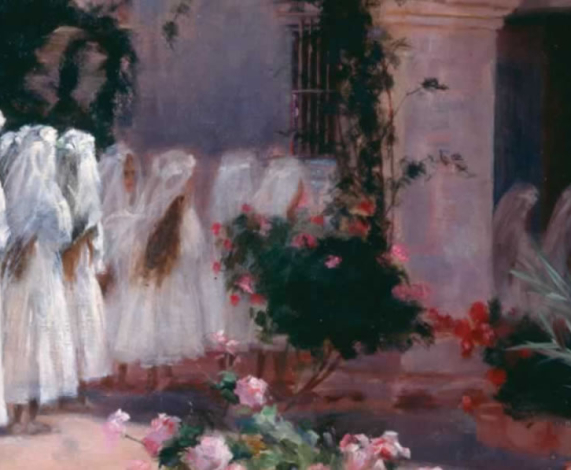
Fred Behre and John Gutzon Borglum. Mission San Juan Capistrano, painted 1894, printed and hand-tinted early to mid 20th century. Gift of Mabel Langenberger Aiken, 8664. ©Bowers Museum
In 1769, Gaspar de Portola, the Spanish Governor of the Californias, and Father Junipero Serra, a Franciscan missionary, led an expedition north from Baja California into coastal Alta California, today part of the State of California, to convert Indigenous peoples to Catholicism and secure Spanish control of the region. Twenty-one missions were built and connected by El Camino Real, each about a day's ride apart, near water and fertile land. Constructed largely by Indigenous labor, the missions extended Spanish influence as far north as Sonoma.
The mission system began to decline after Mexico gained independence from Spain in 1821. The Secularization Act of 1833 transferred mission control from the Church to civil authorities. By 1834, the missions were closed, and their lands sold to private owners. Wealthy individuals acquired large tracts, forming expansive ranchos and building large estates.
Step into this gallery to explore rare artifacts and compelling images from Mission San Juan Capistrano, alongside stories from prominent Southern California rancho families�especially the Yorba, Pico, and Forster lineages. Together, they reveal a rich, complex chapter of our state's past and the people who defined it.